
Jvari Monastery, Georgia: History, How to Get There & Visitor Guide
Jvari Monastery near Mtskheta sits above the confluence of two rivers and is part of Georgia's first UNESCO site. History, architecture, how to get there by rental car or taxi from Tbilisi, hours and tips.
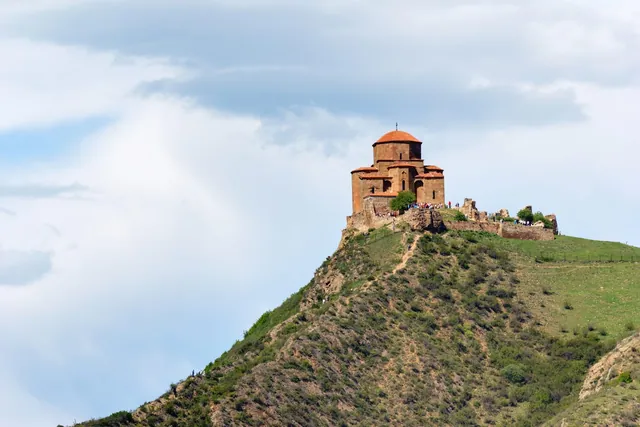
Jvari Monastery stands on a hilltop above the meeting point of the Mtkvari and Aragvi rivers, about 12 miles (20 km) north of Tbilisi. The church was built at the turn of the 6th and 7th centuries, entry is free, and the drive from central Tbilisi takes 25–30 minutes. There is no public transport up the hill: you get there by taxi or by car.
What Is Jvari and Why Does It Matter
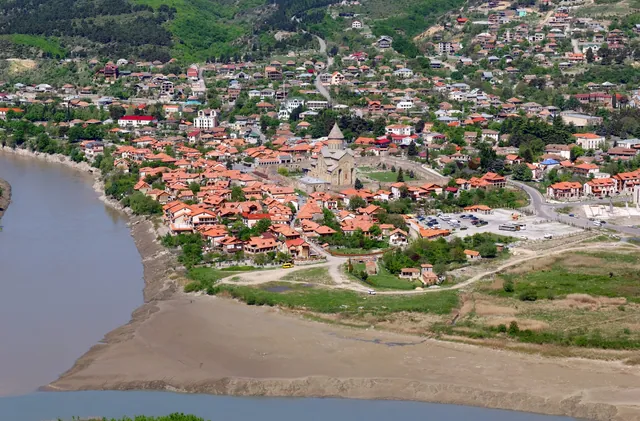
"Jvari" means "cross" in Georgian. The monastery sits on Jvari Mount, 656 metres (2,150 ft) above sea level, directly above the old capital of Mtskheta. From up here you get the view that appears in every guidebook to Georgia: the Aragvi runs into the Mtkvari right below you, and for a stretch the two rivers flow side by side without mixing. The line between them is visible to the naked eye. It's sharpest in late summer and autumn; in spring, when meltwater turns both rivers muddy, the contrast almost disappears.
The terrace is windy almost every day of the year, and the difference from Mtskheta down below is real: it's noticeably cooler up top, especially towards evening. A light jacket earns its space in the bag even in August.
For Russian-speaking visitors this landscape carries an extra layer: the Romantic poet Mikhail Lermontov opened his narrative poem Mtsyri with exactly this view of the two rivers. Scholars still argue about which monastery he actually had in mind, and most point to the churches down in Mtskheta. The panorama, though, is this one.
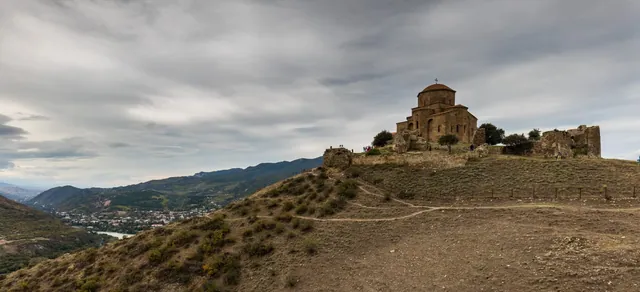
History: From a Wooden Cross to a UNESCO World Heritage Site
The story of Jvari starts in the 4th century AD, when Saint Nino, the woman credited with bringing Christianity to Georgia, raised a wooden cross on this hilltop. Tradition holds that King Mirian III and Queen Nana of Iberia converted soon after, making Kartli one of the earliest Christian kingdoms in the world. Historians give different dates for the conversion, anywhere from 317 to 337 AD, and there is no settled answer.
By 545 AD a small church already stood on the hill; its ruins survive next to the main building. The large church, the one you can see from the highway, went up between 590 and 605 AD under Stepanoz I, the ruling prince of Kartli, whose name appears in the inscriptions on the façade. The architect's name is lost, but the design worked so well that the Jvari tetraconch became the template for Georgian church building for centuries.
In 1994 Jvari was inscribed on the UNESCO World Heritage List as part of the Historical Monuments of Mtskheta, together with Svetitskhoveli Cathedral and Samtavro Monastery. It was the first Georgian entry on the list. In 2004, stone erosion put Jvari on the World Monuments Fund's list of 100 most endangered sites; restoration work followed and it came off that list in 2007. The Mtskheta ensemble as a whole had its own troubled decade on UNESCO's List of World Heritage in Danger, from 2009 until 2016, when it was removed after Georgia introduced a moratorium on construction around the monuments.
Today it's a working Orthodox monastery. Services are held regularly, and the place feels nothing like a museum.
Architecture: Beauty Through Restraint
The church is a tetraconch: a cross inscribed in a rectangle, with four apses. It measures about 72 by 60 feet (22 by 18.4 metres) and rises to roughly 25 metres. The exterior walls carry carved reliefs and 7th-century donor inscriptions, intricate but never excessive.
Step inside and the contrast is striking. There are no frescoes at all, since fresco painting reached Georgia well after Jvari was built. The interior is spare and deliberate: a large wooden cross on a stone pedestal at the centre, a memorial corner on the left, a baptismal font near the entrance, and an icon of the Iverian Mother of God on the right.
The space is small. After the glare outside, your eyes need half a minute to pick out any detail. On busy days there may be a queue to get in, but once you're through the door the noise of tourism falls away.
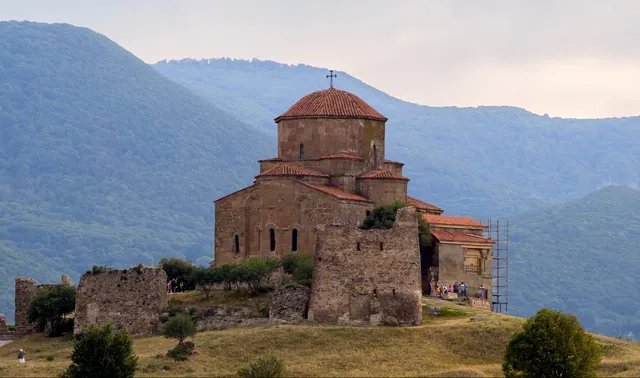
What Else to See: Mtskheta in a Day
Jvari is reason enough to make the trip, but the town directly below deserves your time too. Mtskheta was the capital of the ancient Kingdom of Iberia and is one of the oldest continuously inhabited cities in the world. It's compact enough to cover on foot in a couple of hours.
Svetitskhoveli Cathedral is the centrepiece: an 11th-century cathedral that serves as the spiritual heart of Georgian Orthodoxy. According to legend, Christ's robe is buried beneath its altar. It's on the UNESCO list alongside Jvari.
Samtavro Monastery is a working convent dating from the 4th to 11th centuries. It holds the tombs of King Mirian III and Queen Nana, the royals who converted after Saint Nino's arrival.
The old town is small but atmospheric: narrow stone streets, wine shops, churchkhela vendors selling walnut-and-grape-juice sweets, and an unhurried pace.
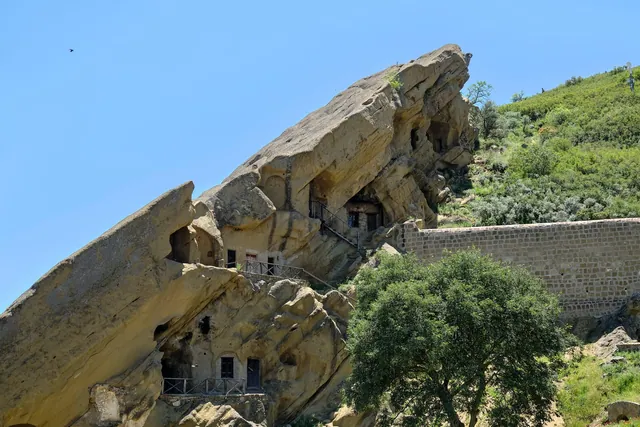
With more time and a car, the cave monastery of Shiomgvime is about 6 miles (10 km) from Mtskheta along a dead-end road that finishes at the gate. Far fewer visitors, completely different atmosphere.
Getting to Jvari Monastery
Here's the practical catch: Jvari sits on top of a hill and no public transport goes up. Marshrutka minibuses from Didube metro station only take you as far as Mtskheta, a 25–30 minute ride for 1–2 GEL, and the climb is a separate problem. Walking up is possible, roughly 40 minutes of steep switchbacks one way. There's almost no shade on that road, and in July you notice it within the first ten minutes.
Your two realistic options:
Taxi. From Mtskheta, local drivers ask around 20–30 GEL for the round trip with waiting time. From Tbilisi, expect 60–80 GEL, again with the driver waiting while you visit. Split between two or three people, that's reasonable. Prices are indicative and climb in high season, so agree the fare before you get in.
Rental car. Tbilisi to the Jvari parking lot is 25–30 minutes on good roads, and the mountain road up is paved and manageable in a standard car. Parking at the foot of the church is large and free, and it's a 2–4 minute walk to the entrance. One day by car comfortably covers Jvari, Mtskheta, Svetitskhoveli and, if you feel like it, Shiomgvime. You can browse available cars at mydrive.club: free delivery anywhere in Tbilisi, no mileage limits.
Practical Information
Location: Jvari Mount, Mtskheta, Georgia. Search "Jvari Monastery" in Google Maps and it comes up straight away.
Opening hours: the monastery doesn't publish an official schedule. The grounds are generally open from early morning until dark, while the church itself is usually accessible until roughly 5:00–6:00 PM. Come during the day if getting inside matters to you.
Admission: free.
Dress code: women need a head covering and a skirt or long trousers. Scarves and wrap skirts are kept at the entrance to borrow and leave behind on the way out.
Shopping: souvenir stalls in the parking area sell churchkhela, local wine, icons and magnets. Nothing is sold up at the monastery itself.
Restrooms: a small public toilet sits near the parking lot, though it isn't operational year-round.
Time to budget: 40 minutes to 1.5 hours for the monastery alone. Combined with Mtskheta, plan at least half a day.
What to bring: water and a windproof layer. It's exposed up there and there's nothing to buy on the hill.
Best Time to Visit
Spring (April–May): comfortable temperatures (60–70°F / 15–22°C), green hills, manageable crowds. Probably the best window.
Summer: hot, up to 95°F (35°C). Go early morning or at sunset for better light and fewer people.
Autumn (September–October): golden vineyards, warm evenings, soft light. Ideal for photography.
Winter: near-empty grounds, possible snow, dramatic views. The switchbacks can ice over, so book a car with winter tyres or all-wheel drive. Summer tyres are not an option on that climb in the cold.
A Few Tips Before You Go Up
Go on a weekday, early or late. By eleven in the morning the parking lot fills with tour buses and the church interior gets tight.
Walk the full perimeter of the grounds. The views shift as you move, and the best angles aren't always the obvious ones.
If you're driving, stop in Mtskheta on the way back rather than pushing straight to Tbilisi. Park near the old town and walk; the centre takes about an hour on foot.
Buy water and snacks at the stalls by the parking lot. Higher up, on the monastery grounds, there's nowhere to buy anything.
The Short Version
Jvari is part of Georgia's first UNESCO site and the easiest way to see the confluence of the Mtkvari and Aragvi from above. Entry is free, an hour covers the monastery itself, and paired with Mtskheta it makes a full day half an hour from Tbilisi. Getting up the hill means a taxi or your own car; there's no third option that works. This hill has been watching the two rivers meet for nearly 1,400 years. Go and watch with it.