
Uplistsikhe: The Cave City — How to Get There by Car
Uplistsikhe is a 3,000-year-old rock-cut city 80 km from Tbilisi. How to drive there from Tbilisi, Kutaisi and Batumi, and what to see inside.
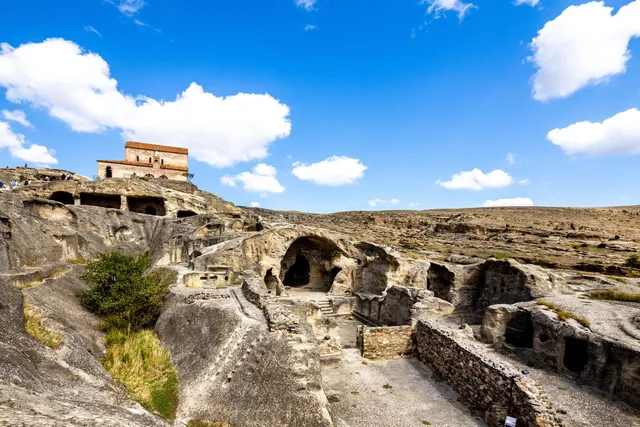
Uplistsikhe is one of the oldest cities in Georgia, cut straight into the rock on the bank of the Kura. It is more than three thousand years old, and people lived here until the 19th century. From the highway it looks like an ordinary brown hill — you only realise it is a city when you climb onto the first terrace. And it is right next door: 80 km from Tbilisi, a little over an hour by car.
What Uplistsikhe Is and Why It's Worth the Trip
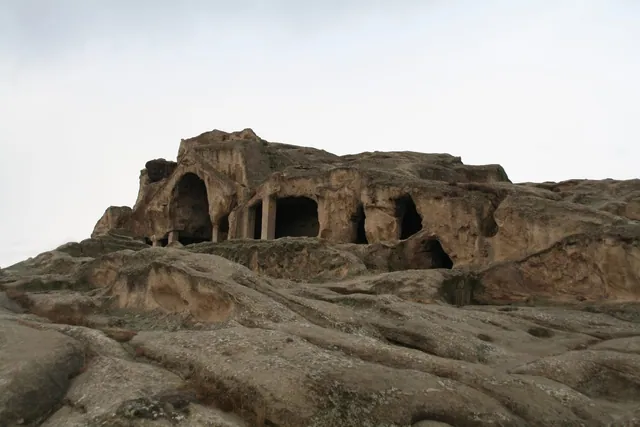
The name translates from Georgian as "the lord's fortress" — and the scale lives up to it. The city is carved into yellow-beige sandstone: streets, houses, a temple, a theatre, a pharmacy, a winery — none of it built, all of it cut out of the stone.
The first settlers appeared here in the 1st millennium BC. The peak came in the 9th–10th centuries: back then up to 20,000 people lived in Uplistsikhe, and the city was effectively the main capital of Kartli. After Georgia adopted Christianity in the 4th century, the pagan temples were rebuilt as churches, but the city did not empty out.
Of the original ~700 cave chambers, around 150 survive today. That sounds like "only a third is left", but on site it is more than enough: two or three hours pass unnoticed if you don't race between the signposts.
What to See Inside
The entrance to the complex is across a bridge over the river. Then comes the climb up stone steps, polished glassy in places, so your soles slip. There are signs, but not many — a guide for a group costs 45 GEL, an audio guide 15 GEL. We took the audio guide and didn't regret it: without one, half the chambers read as nothing more than "a pit in the rock".
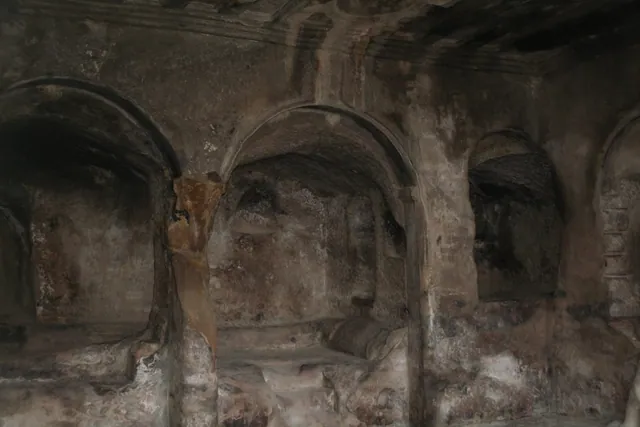
Queen Tamar's Hall — the best-known chamber. The stone arches, carved beams, bas-reliefs and a deep well in the centre have all survived. Legend has it that this is where Tamar was crowned — the most revered ruler in Georgian history.
The Uplistsuli church — a 10th-century medieval basilica with a distinctive russet tiled roof, visible from a distance. It is still active: baptisms and weddings are held here to this day.
The underground tunnel — a system of passages that brought water from the river into the besieged city. Several thousand years old. Fully preserved — and noticeably colder inside.
The theatre, the pharmacy, the wineries — chambers whose functions read clearly. The grape presses and qvevri jars cut straight into the cave floors are especially interesting: people here were doing exactly what a Georgian courtyard still does today.
Next to the exit there is a small tasting room: 3 kinds of wine, 2 kinds of chacha and snacks for 20 GEL. After the climb, it goes down well.
Admission is 15 GEL for adults, 5 GEL for children, free under the age of 6. The complex is open all year round. Allow 1.5–2 hours for the visit.
In the heat (July–August) it is better to come early in the morning or after 5 pm: the rock bakes and there is practically no shade. Water is non-negotiable.
Getting There from Tbilisi
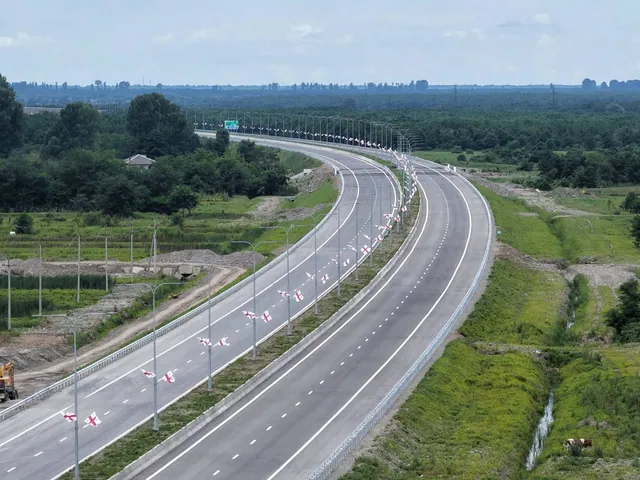
By car is the most convenient option. ~80 km, and the route is simple: the E60 highway west towards Gori, then the turn north at the sign for Uplistsikhe. Travel time — 1 hour to 1 hour 15 minutes.
A one-day route out of Tbilisi:
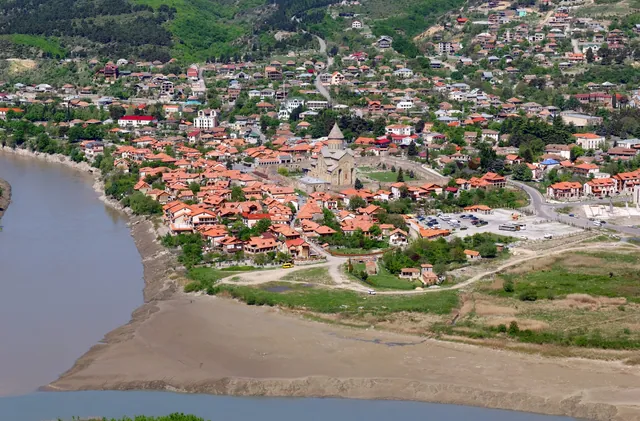
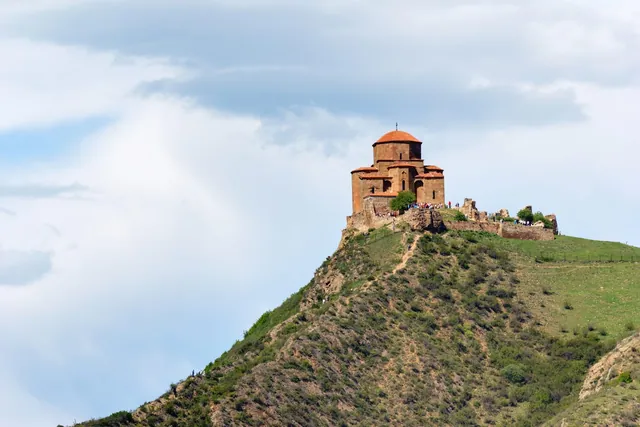
- Tbilisi → Mtskheta (20 min) — Svetitskhoveli, Jvari Monastery
- Mtskheta → Gori (50 min) — the Stalin Museum, if you fancy it
- Gori → Uplistsikhe (15 min) — 1.5–2 hours on site
- Uplistsikhe → Tbilisi (1 hr 15 min) — back along the E60
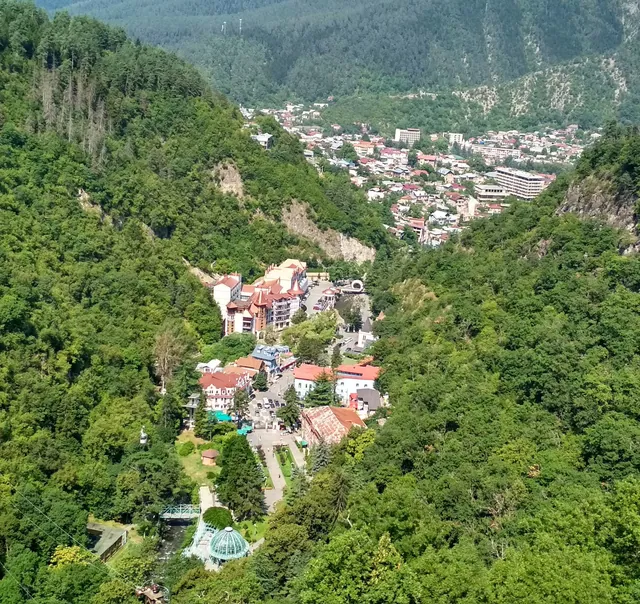
Or carry on towards Borjomi — in which case you'll need an overnight stay.
Renting a car in Tbilisi and driving here yourself is the most convenient format available today: you decide when to set off and how long to sit up on the terraces. Booking with no hidden fees and free delivery within the city: mydrive.club.
Getting There from Kutaisi
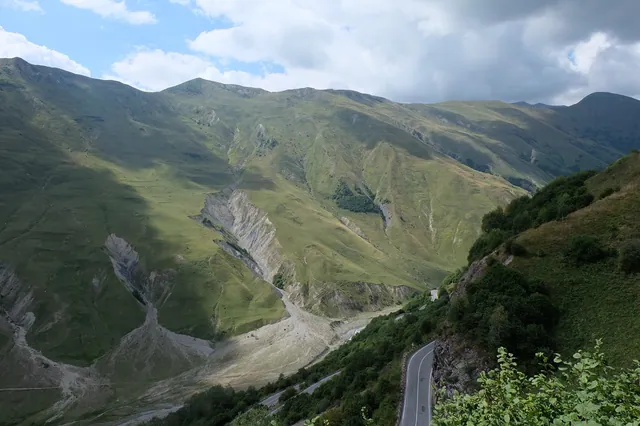
~110 km east along the E60, about 1 hour 30 minutes. The road is flat, there are no passes — frankly boring to drive, and that is a compliment. Uplistsikhe makes a convenient stop on the way from Kutaisi to Tbilisi: the detour is minimal.
The optimal plan: leave in the morning, two hours at Uplistsikhe, lunch in Gori, Tbilisi by evening.
Getting There from Batumi
~220 km, around 2.5–3 hours along the E60. Driving out from Batumi and back specially is a stretch: six hours behind the wheel for two hours on a cliff. The best option is to build Uplistsikhe into the route from Batumi to Tbilisi.
If you are travelling by car for several days, the route Batumi → Borjomi → Uplistsikhe → Tbilisi is one of the most varied in Georgia: the sea, a mountain spa town, ancient history and the capital — one after another, with no backtracking along the same road.
Is It Worth Combining with Gori?
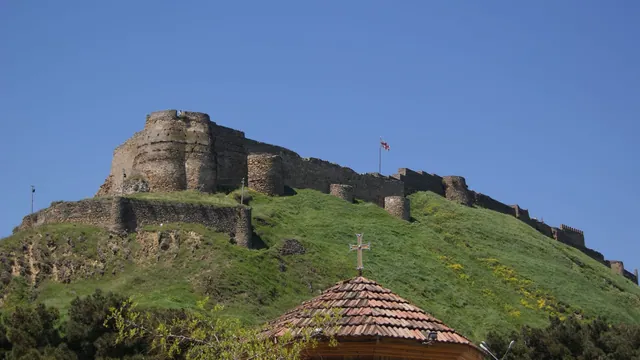
Gori is 15 km from Uplistsikhe — most tourists put the two together in one day. The main draw is the Stalin Museum: large in scale, ambiguous, but interesting; you come out puzzled rather than impressed. There is also the Goristsikhe fortress — free entry, a good view over the town.
If Soviet-era history doesn't appeal, Gori is still handy for lunch. Prices are low and the choice of cafés is decent.
The Bottom Line
Uplistsikhe is not just "one of the sights". Three thousand years of unbroken life inside a single rock is something you feel physically: the steps are worn down by other people's feet, the walls still carry tool marks. Getting there is simple, admission costs 15 GEL, and it is an entirely independent trip: no tours, no timetable. A car, a map, an hour and a half of driving from Tbilisi.