
Tbilisi to Batumi by car: route, stops and how long it really takes
About 380 km from Tbilisi to Batumi along the E60: real driving times, the state of the road, stops in Gori, Uplistsikhe and Kutaisi, seasons and traffic, which car you need and where to get one.
There are three ways to get from Tbilisi to the sea. The train is the calmest: five hours and change, a proper seat, a bistro car — but you arrive where the rails go, exactly when the timetable says. The marshrutka is cheap and runs on schedule, with zero stops for "look how pretty that is" and someone else's playlist for the whole cabin. Your own car is the only option where Gori, Uplistsikhe and Kutaisi stop being separate trips and become part of the way to the coast.
By road-trip standards the distance is modest — about 380 km — but the whole country fits inside it: the dry Kartli plain, vineyards, the tunnels of the Rikoti Pass, humid green Imereti and, at the end, the palms of Adjara. In our experience this is the leg people most often remember as "the best thing we did in Georgia" — provided they didn't blast through it in one five-hour go.
Below: what the road is actually like now, realistic timings, where it's worth stopping, when to go, which car to take and what to do with it once you're in Batumi.
Route, distance and driving time
There is essentially one road — the E60 / S1, the country's main east–west motorway. The sequence is simple: Tbilisi → Mtskheta → Gori → Khashuri → Zestafoni → Samtredia → Kobuleti → Batumi. Kutaisi sits slightly off to the side and needs a short detour.
- Distance: 370–390 km, depending on where in Tbilisi you start and whether you drop into Kutaisi.
- Pure driving time: 4.5–5 hours without stops.
- Realistically, with stops: 6–8 hours — in other words, a full day.
- The comfortable version: two days, with a night in Kutaisi.
Your navigation app will almost always give you an optimistic number. It doesn't budget for fuel, coffee, or twenty minutes of "let's get out, it's beautiful here". If you want to be in Batumi for dinner, count on seven hours and leave in the morning.
One more piece of good news: there are no toll sections on this route. Vignettes, transponders and barriers simply don't exist for passenger cars in Georgia — more on that in our piece on Georgia's "toll" roads.
What the road is actually like
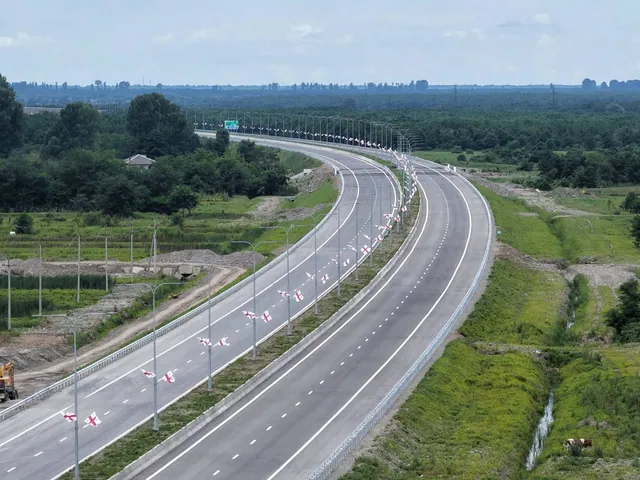
If you last drove to Batumi five or seven years ago, delete the old picture. Today roughly 95% of the way from Tbilisi to the sea is a proper divided highway: two lanes each way, smooth asphalt, markings, crash barriers, clearly signed exits. It's comfortable even if it's your first time driving in Georgia — this is no longer a serpentine adventure, it's an ordinary motorway.
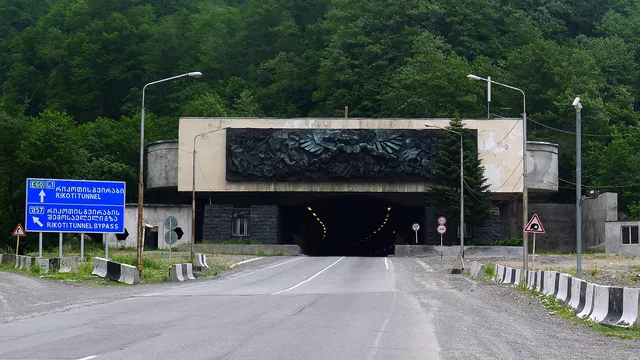
The Rikoti Pass between Khashuri and Zestafoni used to be the slowest part of the trip: a narrow serpentine, trucks, overtaking on faith. The new road with its tunnels and viaducts is now fully complete. The pass no longer eats your time or your nerves. If "old Rikoti" is still in your memory, cross it out — that's a different route.
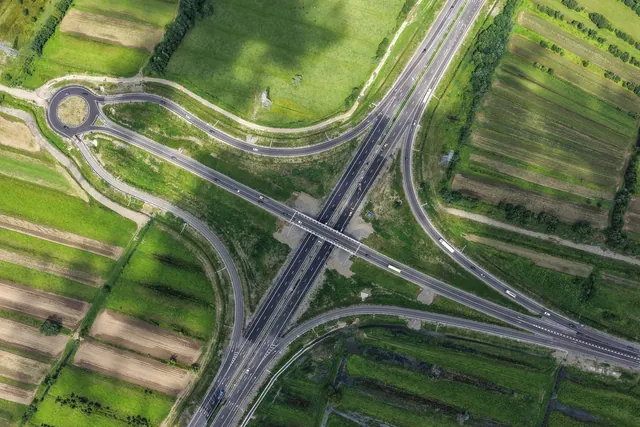
Everything feeding into the motorway was rebuilt along with it: instead of old junctions where you turned left across oncoming traffic, there are now proper interchanges with slip roads. Getting on and off the highway no longer takes a separate act of courage.
What's still unfinished amounts to two short sections. They are promised for 2026–2027. On those stretches the road narrows temporarily, with diversions and a tighter speed limit. That's minutes, not hours: you clear them and you're back on full motorway. It's there — not "along the whole E60" — that it makes sense to slow down and keep an eye on oncoming traffic.
On the motorway itself the base limit is 110 km/h. The cameras work, including average-speed ones that measure your pace between two points, so braking just before the pole won't help. Details are in our guides to Georgia's traffic rules and traffic fines.
There are plenty of trucks on the E60: this is the main transit corridor from Azerbaijan and Armenia to the Black Sea ports. On climbs they slow the left lane down, but on a divided highway that's just a lane change. Optimistic overtaking belongs to the past — except on those two unfinished pieces.
The one place where the pace drops for a reason other than construction is the approach to the sea through Kobuleti: traffic lights, pedestrians, dense summer traffic. It isn't a "bad road", just a different mode — add twenty minutes and don't let it get to you.
When to go
May–June and September are the best months for the drive itself. Western Georgia is green, the heat isn't (or is no longer) draining, and there's less traffic than at peak season. September has the added bonus that the sea in Batumi is still warm while the queues at the seafront cafés are gone.
July–August is the peak. You can and should still drive it, with two caveats: without a working air conditioner this leg becomes an ordeal, and Friday afternoon heading out of Tbilisi towards the coast is the busiest window of the week. Half the country is going to the sea at the same time as you. The return wave is Sunday evening. If you have the choice, start early on a weekday.
October–November is quiet, cheap and very green, but the rainy season begins in Adjara: the subtropics take their rainfall quota seriously. Wipers and decent tyres matter more than a swimsuit.
Winter is underrated. Unlike the Georgian Military Highway with its pass and avalanches, the E60 is usually clear in winter: serious snow on the motorway is rare, and Batumi lives all year round. There are still caveats — around Rikoti you can get wet snow and fog, and it gets dark early, so leave earlier and don't push it at dusk.
Stops along the way
These points are the main argument for taking a car. All of them are on the highway or a couple of dozen kilometres off it. The motorway is exactly what lets you pull off calmly, spend a couple of hours somewhere and get back up to speed without feeling you've fallen out of your route.
Mtskheta — 20 minutes from Tbilisi
Georgia's ancient capital sits right at the exit from the city; the detour is minimal. If you haven't seen it yet, half an hour at Svetitskhoveli is the right way to start the day. If you have, drive on with a clear conscience — there's plenty ahead. Details in our Mtskheta guide.
Gori and Uplistsikhe — 85 km, the main stop of the first half
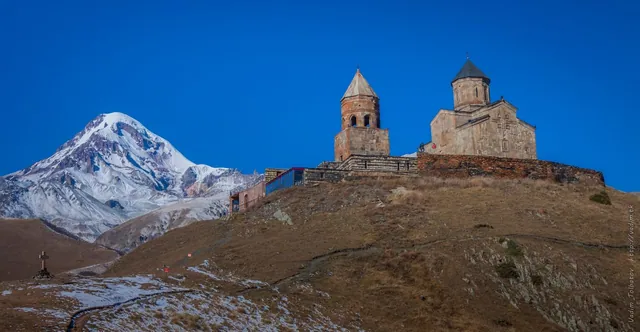
Gori is a little over an hour from Tbilisi. Gorisikhe fortress stands on a rock above the town, entry is free and round the clock, and the views over the Kura and the Caucasus range are excellent. The Stalin Museum is a complicated piece of history, but it's worth seeing if only for the armoured railway carriage; budget an hour and a half to two hours and remember it's closed on Mondays.
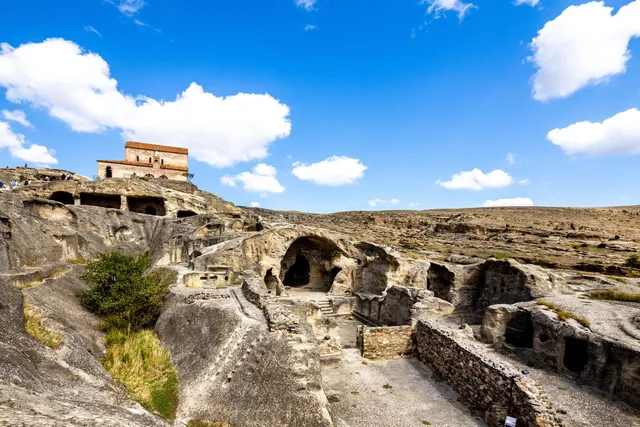
Ten to fifteen kilometres from Gori is the cave city of Uplistsikhe, and on this route it's essential. A three-thousand-year-old town carved straight into the sandstone above the river: streets, Queen Tamar's hall, wineries with qvevri set into the floor, a tunnel down to the water. Allow an hour and a half to two hours; entry is 15 GEL. In summer come before eleven — there's no shade at all on the rock and the stone bakes.
The turn-off to Uplistsikhe takes about fifteen minutes each way on asphalt. Gori plus Uplistsikhe is half a day, so fitting them and Kutaisi into a single leg only works with an early start.
Kutaisi — 230 km, the logical middle of the route
Georgia's second city lies roughly halfway and slightly off the motorway: the detour plus getting back costs twenty to thirty minutes. Kutaisi is noticeably older and calmer than Tbilisi — Bagrati Cathedral on its hill, green streets, a loud Colchian market selling spices and cheese, and Gelati Monastery 10 km from the centre with its twelfth-century mosaics.
Two hours is enough for a quick stop and lunch. The city plus Gelati is half a day. If this isn't your first trip to Batumi, this is the smartest place to break the journey and stay the night: tomorrow you'll have just two and a half easy hours left to the sea.
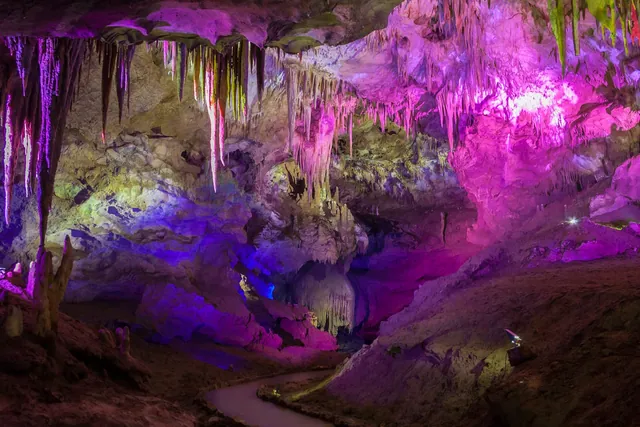
Near Kutaisi is western Georgia's strongest natural attraction: Prometheus Cave, 20 km from the city. A kilometre and a half of chambers, an underground river with a boat, and a steady +14 °C inside, which in August feels like a reward. The tour takes an hour to an hour and a half, but with the drive and the seasonal queue, budget three. A little further north is Martvili Canyon with its turquoise water — but that won't fit into the same day as the cave and the transfer to Batumi.
Zugdidi and Samegrelo — a detour for those with a spare day
Technically Zugdidi is off the Batumi road: it's the north-west, the gateway to Svaneti. But if your schedule has slack, Dadiani Palace is worth it: the residence of the Mingrelian princes, one of the world's three death masks of Napoleon, and 52,000 items in the collection. Plus Mingrelian food, which is spicier and richer than anything you ate in Tbilisi.
Another way to head off-piste is Gomis Mta in Guria: a high-mountain resort with no hotels and no shops, where people come for the sea of clouds beneath their feet. A nice two-day loop looks like this: Tbilisi → Gomis Mta with an overnight → Batumi. The road to the top has been resurfaced and an ordinary car will make it.
The coast: Shekvetili, Ureki, Kobuleti
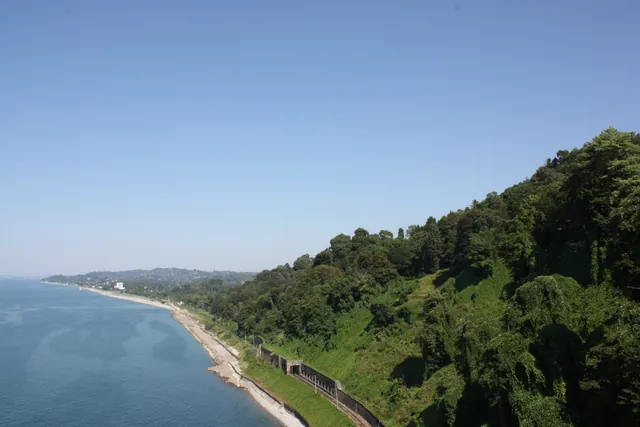
The last 60–70 km run along the sea, and by then it's a drive rather than pure transit. On the way:
- Shekvetili Dendrological Park — 60 hectares of mature trees brought in from across western Georgia, flamingos on the lake, a bamboo grove. Free entry, free parking, an hour or an hour and a half is plenty. A great stretch of the legs after four hours of driving.
- Ureki — beaches of black magnetic sand where Georgian families come with their children.
- Kobuleti — the long resort strip before Batumi. In summer it's denser and slower than the motorway: villages, traffic lights, pedestrians. This is exactly the section where the pace drops because of resort life rather than roadworks.
Arriving in Batumi: traffic, parking and what next
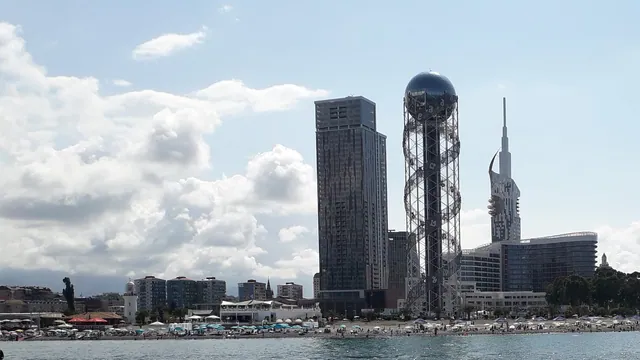
Batumi is compact and logical: sea on the left, mountains on the right, hard to get lost, navigation behaves. In high season it gets dense around the boulevard, the old town and Europe Square — on July and August evenings a couple of blocks can take twenty minutes. It's easier to drive into the centre before noon or after nine in the evening.
Parking in the centre is trickier than it looks: there are paid zones, few free spaces in season, and hotel parking is far from guaranteed — that's a question to ask before booking your accommodation, not after. Many people leave the car a block or two from the seafront and walk: you can cross central Batumi on foot in half an hour.
But the main point is this: in Batumi you need a car not for the city, but for everything around it.
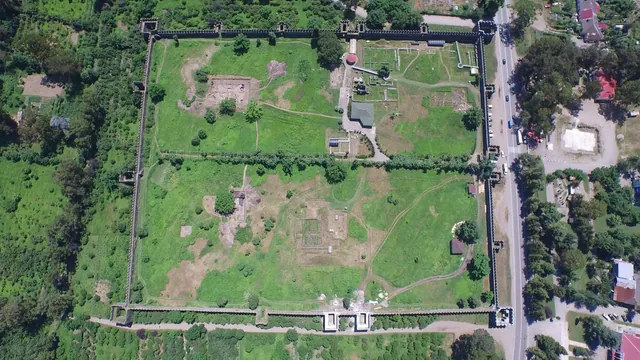
- Gonio Fortress, 15 km south — two-thousand-year-old Roman walls right by the road, with the pebble beaches of Gonio and Kvariati next door and Sarpi and the Turkish border beyond. The Batumi–Sarpi stretch runs right along the sea and is one of the few places in Georgia where a convertible genuinely makes sense in summer.
- Batumi Botanical Garden, 9 km north on Green Cape — 113 hectares of subtropics terraced above the sea. Come at opening time and allow three hours.
- Queen Tamar's Bridge and Makhuntseti Waterfall — 30 km east into mountainous Adjara: an eleventh-to-thirteenth-century arched bridge with no supports in the riverbed, and a thirty-metre waterfall across the road from it. Forty minutes each way, free entry.
- Mountain Adjara further on — Keda, Khulo, the cable car over the gorge and the road up to Goderdzi. The asphalt runs out closer to the pass, so the upper section needs ground clearance and a rental agreement that allows those roads.
Without a car all of this turns into marshrutkas, taxis and haggling on the roadside. With one, it's an ordinary day with a single parking spot by the sea.
Which car to take
For the Tbilisi — Batumi road itself an ordinary sedan or hatchback is enough. This is a motorway, not a mountain serpentine: all-wheel drive and high clearance aren't needed. There's no point paying extra for an SUV for this route.
What actually matters:
- Air conditioning. Not "listed in the options" — working. On the plain near Samtredia in summer, it isn't a luxury.
- Transmission. In Kobuleti traffic and on the Batumi seafront, an automatic is noticeably more comfortable, especially if it's been a while since you drove a manual.
- Fuel consumption. 380 km one way is a real tank; a small one-litre hatchback saves more here than you'd think.
- Boot space. A trip to the sea means suitcases, not a daypack.
An SUV only makes sense if after the beach you're planning mountain Adjara above Khulo, the roads of Racha or climbs to the far waterfalls. A convertible is a lovely idea for exactly one stretch, the coastal Gonio — Sarpi run; on a four-hour motorway transit under the sun it will mostly wear you out. To work through the options, see which car to choose and jeep or sedan.
Practical tips
- Departure. Before 9 a.m., and before 8 on a summer Friday. It's the one piece of advice that saves both time and temper.
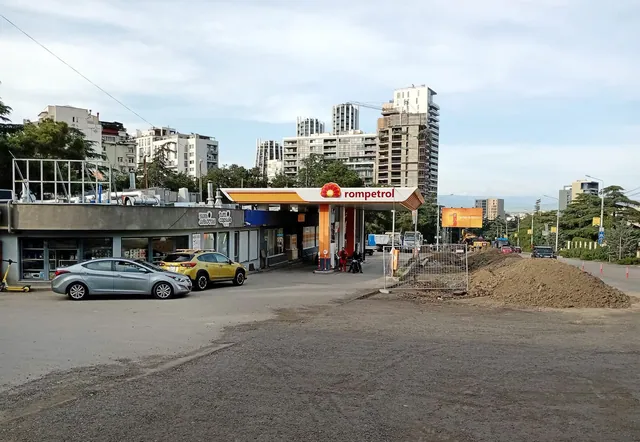
- Fuel. There are plenty of stations along the E60, with the big chains (Wissol, SOCAR, Gulf, Rompetrol) present the whole way. As a budget guide, expect roughly 85–90 GEL of fuel one way for a crossover. Details in our fuel station guide.
- Cash. Cards work almost everywhere, but roadside stalls with churchkhela, honey and peaches, parking attendants at the sights and small cafés in Imereti run on lari. Keep a couple of notes in the glovebox.
- Food. The best lunch stop is Gori (cheap and fast) or Kutaisi (good and worth the time). Between them there are decent roadside cafés on the motorway itself, but it's pot luck.
- Fines. They're issued against the plate and surface at the rental company. You can check and pay them online — better done before you hand the car back.
- Speed. Hold 110 on the motorway and watch the signs at the unfinished sections, where the limit is usually lower. In Kobuleti and Batumi itself, the pace is urban.
- Rain. In Adjara a downpour can come down like a wall, and water pools on the asphalt fast. Speed down, distance up.
Where to get a car
For the Tbilisi — Batumi route there's one clause in the contract that people forget most often: the rental must allow intercity trips. Far from every company permits them by default — some set a mileage cap, some ban leaving the region outright, and you find out about it on the highway. Ask before signing, and ask for the permission in writing rather than as a verbal yes. While you're at it, check the daily kilometre limit: 760 km there and back easily exceeds it at companies that set one. Everything else worth checking at handover — from insurance to the deposit — is collected in the rental car pickup checklist.
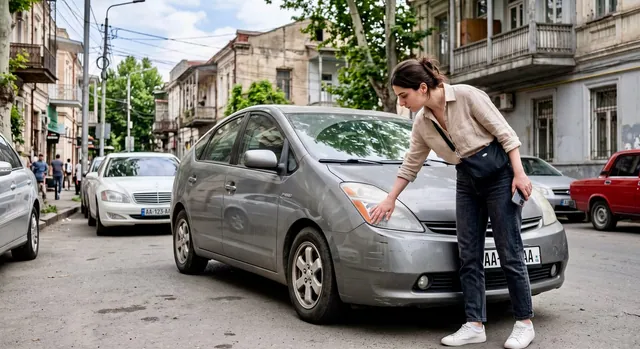
MY.DRIVE is a rental service that allows exactly this kind of trip: intercity routes within Georgia don't need separate approval, the contract is transparent, and support stays reachable for the whole drive. There are cars in the capital and around the country — from simple automatics for the motorway to crossovers for mountain Adjara.
The reverse scenario works too, and is often more convenient. If you're flying straight to the sea, it makes sense to pick the car up right at Batumi airport: about 15 minutes from the terminal to the seafront, and Gonio is on the way anyway. Plenty of people take a car in Batumi for a week by the sea and then drive to Tbilisi along the same E60 — in the other direction and with different stops.
The bottom line
Tbilisi — Batumi isn't a transfer, it's a journey the length of a country. 380 km of almost-finished motorway, 4.5–5 hours of clean driving and at least half a day of stops that are the whole point: a rock city three thousand years old, a cathedral on a hill in Kutaisi, a cave with an underground river, and palms at the end.
Three things to remember. Leave early — especially in summer and especially on a Friday. Don't try to take Gori, Uplistsikhe, Kutaisi and Prometheus in one day — either pick two of them or sleep in Kutaisi. And confirm intercity trips with the rental company before you load the suitcases.
Have a good drive. Pick a car for the route at mydrive.club.